




WHAT IS TQM?
- Total quality management (TQM) is demonstrated as a quality-oriented management system based on the participation of every member in order to bring about long-term success through satisfying customer requirement and benefits of all members and society.
- TQM has become one of the most influential method in over 30 years which was applied to various forms of businesses.
Objective of TQM is to enhance quality of products and to satisfy customers at best. The distinguished feature of TQM is that it provides a comprehensive system for management and improves all aspect related to quality and mobilizes participation of departments and individuals.
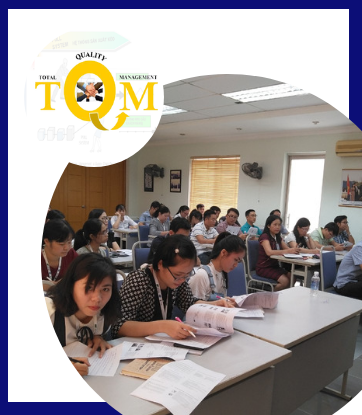
TQM comprehensive quality management system pre-audit program is designed specifically to fit the needs of the business. The content of the pre-audit program is based on the jobs and accompanied by the on-site deployment guidance with appropriate tools, based on experience of experts in pre-audit, pre-audit and application of TQM in different units.
Agenda
|
Content |
Duration |
|
Phần I: Introduction of TQM |
Day I: Morning |
|
What is quality? The importance of quality |
8:30 – 11:30 am Who should join: Leaders/Steering board, Head/Deputy of departments, Officers of Quality Department, anyone concerns |
|
History of quality development |
|
|
Concept and types of quality in organization/ business |
|
|
The principle of comprehensive quality |
|
|
Conventional model and TQM |
|
|
What level of TQM is the company at? |
|
|
The quality ancestors and their quality philosophy |
|
|
Comparison between TQM and other systems |
|
|
Objectives of TQM |
|
|
TQM model adoption |
|
|
Organizational structure implementing TQM in the company |
|
|
Regular module of TQM |
|
|
Part II: Leadership in TQM |
Day I: Afternoon |
|
What is management? |
1:30 – 4:30 pm Who should join: Senior and middle level leaders/ managers
|
|
Role of leader and quality leader |
|
|
Set up Vision – Mission – Value (VMV) |
|
|
Leader with policy implementation |
|
|
Policy implementation matrix and policy practice |
|
|
Introduction of Balance Score Card and KPI in business |
Day 2: Morning – Afternoon 8:30 am – 4:30 pm Who should join: Senior and middle level leaders/ managers |
|
Policy formulation and implementation strategy |
|
|
Authorization |
|
|
Monthly PDCA implementation |
|
|
Evaluation of policy implementation results and KPIs |
|
|
Part III: Design organization based on TQM opinion |
Ngày 3: Buổi sáng |
|
Organizational structure by function |
8:30 am- 12pm Who should join: Leaders/Steering board, Head/Deputy of departments, Officers of Quality Department, officers, operators |
|
Adjustment of organizational structure by TQM |
|
|
Cultural change in TQM organization and culture |
|
|
Continuous improvement |
|
|
Team work and group classification in TQM |
|
|
Board of Directors |
|
|
Problem Solving Team (single function, cross function) |
|
|
Natural working group |
|
|
Self-management group |
|
|
Virtual group |
|
|
Effective method of teamwork |
|
|
Part IV: Daily management |
Day 3: Afternoon |
|
The daily work of management at all levels |
1:30- 4:30 pm Who should join: Senior and middle level leaders/ managers |
|
Importance and management skills of intermediary management |
|
|
Relationship between policy management and daily management |
|
|
Part V: Key Methods and Tools for TQM Implementation |
|
|
|
|
Establishment of internal standards (facilities) |
|
|
Standardized communication |
|
|
Standardized daily work |
|
|
Work Instruction |
|
|
Day 4: Morning – Afternoon 8:30 am – 4:30 pm Who should join: Officers of Quality Department, officers, anyone concerns |
|
What causes errors and defects |
|
|
1. Check cards |
|
|
2. PARETO chart |
|
|
3. CAUSE AND CONSEQUENT chart |
|
|
4. DISPERSION chart |
|
|
5. DISTRIBUTION chart |
|
|
6. CONTROL chart |
|
|
7. Flow of cost |
|
|
Day 5: Morning |
|
Construction steps |
8:30 – 11:30 am Who should join: Everyone |
|
Implementation instruction |
|
|
Establishment of incentive and reward mechanisms |
|
|
Maintain and report on proposed activities |
|
|
Ngày 5: Buổi chiều |
|
What is quality group |
1:30 – 4:30 pm Who should join: Officers of Quality Department, officers, anyone concerns |
|
Quality group philosophy |
|
|
The main factor to succeed |
|
|
Structure of quality group |
|
|
Steering board of quality group |
|
|
Instruction guide |
|
|
Implementation guide |
|
|
Establishment of incentive and reward mechanisms |
|
|
Maintain and report on proposed activities |
|
|
Organize the quality festival at the company |
|
|
Day 6: Morning |
|
Steps to build 5S and visual management |
8:30 – 11:30 am Who should join: Everyone |
|
Implementation guide |
|
|
Establishment of incentive and reward mechanisms |
|
|
Maintain and report on proposed activities |
|
|
Continuous improvement of 5S |
|
|
Day 6: Afternoon |
|
10 principles of Kaizen |
1:30 – 4:30 pm Who should join: Officers of Quality Department, officers, anyone concerns |
|
Kaizen route |
|
|
Steps to implement Kaizen |
|
|
Categorize issue requiring Kaizen |
|
|
Kaizen and project management |
|
|
Organizational structure of Kaizen group |
|
|
Organize Kaizen event |
|
|
Establishment of incentive and reward mechanisms |
|
|
Maintain and report on Kaizen activities |
|
|
Continuous improvement of Kaizen |
Objectives of the course
After the pre-audit course, participants can:
- Know the position of TQM in the development of quality improvement methods
- Understand the basic principles of TQM and its impact on the efficiency of production / business
- Know how to plan to achieve a management commitment to improve quality
- Describe how to empower employees to adopt the best quality approach in practice
- Know how to use statistics and real-world data to determine the process of solving problems that are of a quality and sustainability, preventing the repetition of everyday problems.
- Know how to use advanced continuous improvement tools and techniques.
- Identify the changes needed in your organization to achieve improvement
- Know how to build teamwork and group improvement activities
- Know how to maintain TQM refinement and incentive schemes.
Review and Q&A
Review
0 review
0 Comment